Mizanur Rahman
- Mizanur Rahman
- 17065
- A
- 485
- 17 years old
- Student
- 7 members
- Sylhet, Bangladesh
A Brief Background and Experience During the July 2024 Uprising
“দুই চোখে কত স্বপ্ন ছিল। অনেক বড় হওয়ার আশা ছিল। কিন্তু হঠাৎ করে জীবনে কালবৈশাখীর ঝড় এসে সবকিছু তছনছ করে দিলো।”
Only a few months before the July Mass Uprising, Mizanur Rahman experienced the first major tragedy of his young life. In March 2024, his father died of lung cancer, leaving behind a family already struggling financially. At the time of the uprising, seven family members, including Mizan, his mother, siblings, sister-in-law, and his bedridden grandmother shared a modest two-room rented home in Sylhet.
Before his father’s death, both of his parents worked as caretakers to support the family. Despite their limited means, they remained committed to educating their children. Mizan was studying in a madrasa, while his eldest brother had recently completed his education and was just beginning his married life.
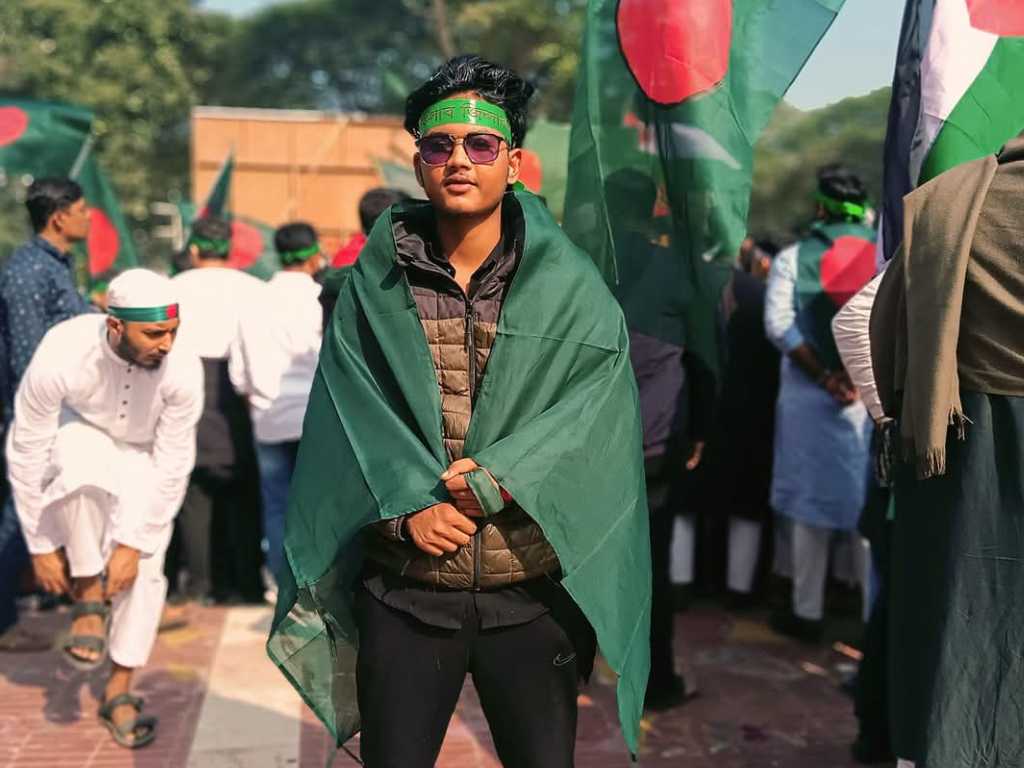
When the July Mass Uprising began, Mizan joined thousands of young Bangladeshis demanding justice and democratic rights. On 2 August 2024, he was shot by police during a protest in Sylhet. Despite his injuries, he refused to leave the movement. The following day, he was shot again, sustaining additional injuries to his hands and legs.
On 4 August, carrying the national flag and a protest placard, he returned to the demonstrations once more. After being injured, he was first taken to Trust Hospital where, according to Mizan, he was told that the hospital could not treat people injured during the uprising. He was then transferred to Osmani Medical College Hospital.
Instead of receiving immediate treatment, Mizan was placed in the hospital’s detention ward because of his participation in the protests. Blood continued to pour from his injured eye, staining the white tiled floor. About an hour later, his mother arrived, followed by his brother. Together they pleaded with the police officers guarding him, promising they would remain in the hospital and not attempt to take him away if only he could receive urgent treatment. After nearly two hours of pleading, he was finally taken for medical care. Looking back, Mizan says those two hours were the longest and most painful of his life.
Even then, he did not tell the doctors he had been injured during the protests because he feared the consequences while the government remained in power.
On 5 August, as he prepared for eye surgery, a doctor quietly asked him, “Do you know Sheikh Hasina has left the country? Are you still going to say you were not part of the movement?” Mizan thought it was a trick. Only after his mother confirmed the news did he believe it.
From his hospital window, he watched thousands of people celebrating in the streets below.
“That is one regret I will carry for the rest of my life,” he says. “Everyone was celebrating our victory, but I could only watch from the window. Even today, when I think about it, I feel an emptiness inside.”
Rehabilitation Journey and Support from Aparajito-24 Foundation
Mizan underwent surgery on 5 August 2024, but by then the pellet injuries had already caused irreversible damage to his right eye. He was discharged on 13 August with instructions to seek urgent treatment at the National Institute of Ophthalmology and Hospital (NIOH) in Dhaka. His family had no money for the journey, and his brother spent two days borrowing enough money for travel before they could reach Dhaka.
Mizan was admitted to NIOH on 16 August and remained in and out of the hospital for several months. During that time, he began losing vision in his left eye—the only eye he had left. After nearly three months of uncertainty and repeated examinations, doctors diagnosed him with sympathetic ophthalmia, a rare autoimmune disease that threatened to leave him completely blind.
Several months later, Mizan received another devastating recommendation. Doctors advised removing his blind right eye in an effort to protect the vision in his left eye. As luck would have it, that was the same day Aparajito-24 Foundation reached out to him.
Recognizing the urgency of the situation, the Foundation immediately arranged for Mizan’s medical records to be reviewed by an experienced retinal surgeon in the United States. After carefully evaluating his case, the specialist advised that removing the eye several months after the injury would no longer prevent the progression of sympathetic ophthalmia. Instead, preserving the vision in his left eye would depend on lifelong immunosuppressive medication and close medical monitoring.
The specialist also believed that, unlike many other injured protesters whose treatment in Bangladesh had been appropriate, Mizan’s case warranted further evaluation abroad because there might still be treatment options worth exploring for his injured eye.
Rather than waiting for a government decision on overseas treatment, Aparajito-24 Foundation arranged for Mizan to travel to Bangkok, Thailand, in December 2024. Beyond financing the trip, the Foundation coordinated every aspect of his visit, including medical appointments, accommodation, transportation, interpretation, and local support, ensuring that he and his family could focus entirely on his treatment.
Although specialists in Bangkok confirmed that the vision in his right eye could not be restored, they agreed that preserving the sight in his left eye through lifelong medication and careful follow-up was the best course of treatment. Equally important, the consultation gave Mizan and his family confidence that every reasonable treatment option had been explored before accepting his diagnosis.
The medications required to control sympathetic ophthalmia are expensive and must be taken indefinitely. Although government reimbursement was expected, it never materialized. Aparajito-24 Foundation covered the cost of these lifesaving medications for many months, ensuring that his treatment was never interrupted. Today, Mizan receives a monthly government allowance, but much of it is spent purchasing the medications needed to preserve the vision in his remaining eye.
Mizan believes one of the greatest reasons he was able to cope emotionally was the unwavering support of his family. Unlike many injured protesters who were blamed for joining the movement, his family never questioned his decision. His mother often told him that if the country had not changed, she herself would have joined the protests. His brothers stood firmly beside him, and his sister-in-law faithfully reminded him to take his medications and administer his eye drops. Together with ongoing mental health support coordinated by Aparajito-24 Foundation, this loving family environment helped him avoid falling into deep depression.
Recognizing that strengthening the family was also an essential part of rehabilitation, Aparajito-24 Foundation provided BDT 50,000 to Mizan’s eldest brother to start a small business, creating an additional source of income for the household.
Current Situation and Future Aspirations
Today, Mizan continues his education while living with permanent vision loss in one eye and the constant uncertainty of protecting the vision in the other. With lifelong medication, regular monitoring, and specialized care, there is hope that the vision in his remaining eye can be preserved.
Since the uprising, Mizan’s grandmother has passed away, and his eldest brother and sister-in-law have welcomed a baby girl. Although the family’s composition has changed, seven family members still live together in the same modest two-room home under difficult financial circumstances.
The family dreams of returning to their ancestral village in Tahirpur, Sunamganj, where they own a small piece of land. Their hope is to build a modest home and eventually earn a living through farming or a small shop. Because they cannot yet afford the construction costs, they are building little by little. So far, they have managed only to raise the land and build a boundary wall. Aparajito-24 Foundation hopes to help the family move one step closer to realizing that dream as resources become available.
Despite everything he has endured, Mizan has not given up on his future. He hopes to preserve the sight in his remaining eye, complete his education, and build a meaningful life while continuing to support his family.
Mizan’s story is not only one of sacrifice and survival. It is the story of a young man whose dreams were forever changed, yet whose hope remains intact; of a mother’s unwavering love; and of a family that refuses to let tragedy define its future.